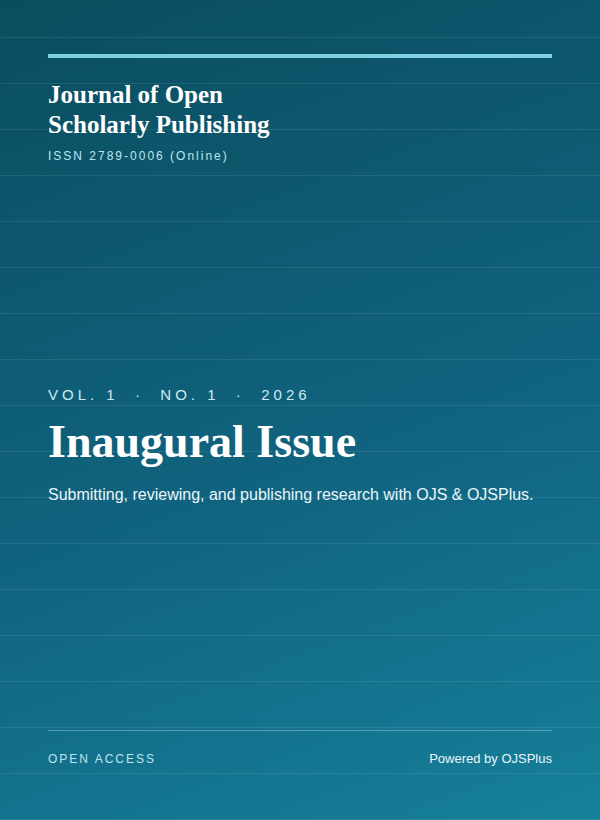
Latest issue cover
Latest IssueVol. 1 No. 1 (2026)
3.82025 Impact Factor
5.22025 CiteScore
All metrics
Editors-in-ChiefDr. Sarah ChenProf. David Okafor

About the journal

Journal of Open Scholarly Publishing (JOSP) is a fully open-access, peer-reviewed journal publishing accessible guides, tutorials, and commentary on scholarly publishing, peer review, and open science — a live demonstration of a modern, well-configured OJS journal enhanced by OJSPlus.

Every article is freely available to read and reuse under a Creative Commons Attribution licence, with no article processing charges and no fees to read. JOSP welcomes contributions across the entire publishing lifecycle — from author guidance and reproducible-research practices to peer-review models, editorial workflows, indexing, persistent identifiers, and discoverability.

Find out more
Journal of Open Scholarly Publishing

Announcements

Current Issue

Vol. 1 No. 1 (2026): Inaugural Issue
					View Vol. 1 No. 1 (2026): Inaugural Issue

The inaugural issue of the Journal of Open Scholarly Publishing (JOSP) brings together practical guides to submitting, reviewing, and publishing research with Open Journal Systems (OJS) and OJSPlus, alongside commentary on open access and the future of scholarly communication.

JOSP is a fully open-access, peer-reviewed journal dedicated to the craft of scholarly communication — how research is written, reviewed, published, and discovered. Every article is freely available to read and reuse under a Creative Commons Attribution licence, with no article processing charges and no fees to read: a diamond open-access model supported by the OJSPlus demonstration programme and the volunteer effort of our editors and reviewers.

This issue is organised into three sections. Editorials introduce the journal and its mission; Tutorials & Guides walk authors and reviewers step by step through registering, preparing a manuscript, navigating double-anonymous peer review, and the full OJS editorial workflow; and Articles examine open-access models, copyright and licensing, indexing and persistent identifiers (DOIs and ORCID), and the path from submission to publication.

Published: 2026-06-15

Editorials

  • Open Infrastructure and the Commons of Knowledge

    Helena Bergstrom (Author)
    Scholarly communication increasingly depends on shared, open infrastructure — software, identifiers, and standards held in common. This editorial makes the case for investing in community-governed infrastructure such as OJS, and warns against the risks of locking the scholarly record inside proprietary platforms.
  • Welcome to the Journal of Open Scholarly Publishing

    Sarah Mitchell (Author)
    i–iii
    Welcome to the inaugural issue of the Journal of Open Scholarly Publishing, a demonstration journal created to show how a modern, fully configured Open Journal Systems installation can look and behave when enhanced by OJSPlus. In this editorial we set out the journal's purpose: to gather practical guidance on submitting, reviewing, and publishing research, and to serve as a living showcase for editors evaluating OJS for a new or migrating title. We explain our commitment to fee-free, diamond open access, our double-anonymous review process, and how the sample articles, policies, and announcements throughout this site illustrate the building blocks of a credible scholarly journal.
  • Sustaining Community-Led Journals

    Rafael Mendes (Author)
    Many of the most important journals are run by small, volunteer-led communities. We examine practical models for long-term sustainability — institutional hosting, library partnerships, and modest collective funding — that keep diamond open-access journals healthy without article processing charges.
  • The Case for Diamond Open Access

    Sarah Chen (Author)
    Diamond open access — free to read and free to publish — is reshaping expectations for scholarly journals. This editorial argues that community-supported, no-fee models offer the most equitable path for emerging fields and under-resourced institutions, and explains how OJS and OJSPlus make such models practical to operate at scale.
  • From Print to Platform: A Short History of OJS

    Grace Thompson (Author)
    Open Journal Systems has shaped two decades of independent publishing. This editorial traces its evolution from a simple workflow tool to a full publishing platform, and reflects on how OJSPlus continues that trajectory toward a more open, modern reader experience.
  • Reproducibility and the Future of the Scholarly Record

    David Okafor (Author)
    Reproducibility is foundational to trust in research, yet it remains unevenly supported by publishing infrastructure. We discuss how journals can encourage open data, code availability, and transparent methods, and how persistent identifiers tie the scholarly record together so that findings can be verified and reused.
  • Trust, Transparency, and the Role of Peer Review

    Maria Alvarez (Author)
    Peer review remains the cornerstone of scholarly quality, but its forms are evolving. This editorial considers double-anonymous, open, and registered-report models, and how transparency in editorial decisions strengthens reader trust without overburdening volunteer reviewers.

Articles

  • Open Access Publishing: Principles, Models, and Benefits

    Lucas Almeida, Sarah Mitchell (Author)
    53–66
    Open access removes price and permission barriers to research, allowing anyone to read, reuse, and build upon scholarship. This article reviews the foundational declarations that defined the movement and distinguishes the main routes to open access: gold, green, and diamond. We weigh the evidence on readership, citation advantage, and global equity, and consider the economics of article processing charges versus community-funded models. We argue that fee-free, diamond open access—supported by efficient open-source infrastructure such as OJS—is an increasingly practical route for scholarly societies, libraries, and institutions that wish to publish high-quality, peer-reviewed work without charging either…
  • Discovery Services and Why Metadata Quality Matters

    Yuki Tanaka (Author)
    Readers rarely arrive at a journal homepage; they arrive through search engines and discovery services. This article analyses how complete, well-structured metadata drives indexing in Google Scholar, DOAJ, and library discovery layers, and offers a checklist for improving metadata quality.
  • Preservation and the LOCKSS and CLOCKSS Networks

    Nadia Ivanova (Author)
    Open access only endures if content is preserved. This article reviews digital preservation strategies for small journals, including the LOCKSS and CLOCKSS networks and the PKP Preservation Network, and explains how OJS journals can enrol to safeguard the scholarly record.
  • The Editorial Workflow: From Submission to Publication

    Olivia Schmidt, David Okafor (Author)
    91–104
    Behind every published article is a sequence of editorial decisions and handoffs. This article maps the full Open Journal Systems workflow—submission, review, copyediting, and production—and explains how editors assign participants, manage discussions, request revisions, schedule issues, and publish galleys. We highlight the small process choices that reduce time-to-decision and improve the experience for authors and reviewers: clear communication, realistic deadlines, and good use of editorial templates. We also discuss managing an editorial team, recording decisions for accountability, and preparing a clean issue for publication. Understanding the workflow end to end helps editors run a journal that…
  • Persistent Identifiers in Practice: DOIs, ORCID, and ROR

    Priya Nair (Author)
    Persistent identifiers connect publications, people, and institutions into a machine-readable graph. This article reviews how DOIs, ORCID iDs, and ROR identifiers are minted and exposed in OJS metadata, and why consistent identifier practice improves indexing, citation, and interoperability.
  • Internationalisation: Running a Multilingual Journal

    Mateo Garcia (Author)
    Scholarship is global, and journals increasingly publish in more than one language. This article examines multilingual metadata, locale configuration, and translation workflows in OJS, and how supporting several languages widens both authorship and readership.
  • Indexing, DOIs, and Making Your Research Discoverable

    Chen Wei (Author)
    79–90
    Publication is only the beginning of a paper's life; discoverability determines whether it is read and cited. This article covers the infrastructure that makes research findable: persistent identifiers such as DOIs and ORCID, structured metadata for indexing services, and the OAI-PMH interface that lets aggregators harvest a journal's content. We explain how to register DOIs through a registration agency, why clean and complete metadata matters for services like Crossref, DOAJ, and Google Scholar, and how indexing decisions are made. Editors will find concrete, prioritised steps to improve a journal's visibility, from enabling identifiers to auditing the metadata of every published item.
  • Beyond the Impact Factor: Responsible Research Metrics

    James Carter (Author)
    Single-number journal metrics are easy to cite and easy to misuse. Drawing on responsible-metrics principles, this article surveys article-level and field-normalised indicators, and recommends a balanced dashboard that informs readers without distorting research behaviour.
  • Copyright, Licensing, and Author Rights in Open Access

    Nadia Haddad (Author)
    67–78
    Who owns a published article, and what may readers do with it? This article explains how author-retained copyright combines with Creative Commons licensing to enable broad reuse while protecting attribution. We compare the most common licences, clarify what CC BY means for text and data mining, translation, and redistribution, and discuss the implications for authors who wish to deposit their work in repositories. We also offer practical guidance for journals drafting a clear, author-friendly copyright notice, and explain the difference between copyright, licensing, and the version of record. The goal is a transparent policy that benefits authors, readers, and the scholarly record alike.
  • Accessibility and Inclusive Design for Online Journals

    Fatima Zahra (Author)
    Open access is incomplete if content is not accessible to all readers. This article examines WCAG conformance, semantic markup, readable typography, and inclusive design patterns for online journals, and how accessible themes widen readership and comply with emerging legal requirements.

Tutorials & Guides

  • Importing and Exporting Content with the Native XML Plugin

    Omar Haddad (Author)
    Moving content between systems is a common task when migrating or archiving a journal. This guide demonstrates the OJS Native XML import/export plugin, covering issues, articles, and users, and how to validate files for a clean, lossless migration.
  • How to Submit an Article: A Step-by-Step Guide for Authors

    David Okafor, Elena Rossi (Author)
    1–9
    Submitting a manuscript to an Open Journal Systems journal is straightforward once the workflow is clear. This step-by-step guide walks first-time authors through every stage: creating an account, starting a new submission, confirming the submission checklist, uploading the manuscript and any supplementary files, and entering the metadata that makes work discoverable. We explain how to choose the right section, how to prepare an anonymised file for double-anonymous review, and what happens after you click submit. We close with practical advice for tracking a submission from the author dashboard, responding to editorial requests, and ensuring a smooth path to a first decision.
  • Writing a Constructive Peer Review Report

    Amara Okeke (Author)
    A good review is specific, fair, and actionable. We outline a practical structure for review reports — summary, major points, minor points, and a clear recommendation — and offer guidance on tone, scope, and confidentiality within the OJS review workflow.
  • What is OJSPlus? Extending OJS for Modern Journals

    Ahmad Karimi (Author)
    44–52
    OJSPlus builds on Open Journal Systems with contemporary, magazine-quality themes, simplified hosting, and editorial tooling, while preserving the openness, metadata standards, and workflow rigour that make OJS trusted worldwide. This article explains what OJSPlus adds and, just as importantly, what it does not change: your content, data, and editorial process remain standard OJS, so there is no lock-in. We describe the richer reading experience OJSPlus themes provide, how they stay compatible with upstream releases, and how a journal can adopt a modern look without sacrificing accessibility or interoperability. Several live demonstration journals, including this one, showcase the range of designs…
  • Configuring Sections, Roles, and Workflows in OJS

    Tomas Novak (Author)
    This guide walks journal managers through configuring journal sections, assigning editorial roles, and tailoring the submission and review workflow in Open Journal Systems, so the platform mirrors your editorial process from submission to publication.
  • Getting Started with Open Journal Systems (OJS)

    María González (Author)
    32–43
    Open Journal Systems is the most widely used open-source journal platform in the world, powering tens of thousands of titles. This primer introduces the OJS editorial workflow and the roles of editors, reviewers, authors, and journal managers, then walks through the core settings that turn a fresh installation into a working journal: contexts, sections, user roles, submission settings, and the masthead. It is aimed at editors evaluating OJS for a new or migrating title, with pointers to the documentation and community maintained by the Public Knowledge Project. We close with guidance on hosting choices, backups, and keeping an installation secure and current.
  • Understanding the Peer Review Process

    Thomas Berger, Aiko Tanaka (Author)
    20–31
    Peer review remains the foundation of scholarly trust, yet its mechanics are often opaque to new authors and reviewers. This tutorial compares single-anonymous, double-anonymous, and open review, then follows a manuscript through every stage: editor screening, reviewer invitation, assessment, and the decision letter. Authors learn how to read reviewer reports constructively and how to prepare a strong revision-and-response that addresses each point. New reviewers receive a practical checklist for writing fair, specific, and humane reports, declaring competing interests, and respecting confidentiality. We also discuss reviewer recognition and the editor's role in weighing conflicting recommendations to…
  • Galleys and Production: Publishing HTML, PDF, and XML

    Daniel Park (Author)
    A galley is the reader-facing version of an article. This guide explains how to create and order HTML, PDF, and JATS XML galleys in OJS, how to attach supplementary files, and how good production practice improves accessibility, indexing, and long-term preservation.
  • Preparing Your Manuscript: Formatting, References, and Metadata

    Priya Nair (Author)
    10–19
    A well-prepared manuscript moves through peer review faster and reads better in print. This article covers the essentials of manuscript preparation: logical structure and appropriate length, clear section headings, and consistent formatting that assists both reviewers and copyeditors. We discuss preparing figures and tables, choosing a citation style and including DOIs, and writing an informative abstract. Particular attention is paid to metadata—titles, keywords, author names, and ORCID identifiers—because accurate, complete metadata is one of the highest-leverage things an author can get right for long-term discoverability. We also cover anonymising files for double-anonymous review and declaring…
  • Managing the Review Round: Editor Decisions in OJS

    Sofia Romano (Author)
    This tutorial walks editors through a complete review round in OJS — assigning reviewers, sending reminders, recording recommendations, and recording a decision — with practical tips for keeping double-anonymous review fair, timely, and well documented.
  • Creating and Linking Your ORCID iD

    Wei Liu (Author)
    An ORCID iD uniquely and persistently identifies you across the research landscape. This step-by-step guide shows authors how to register an ORCID iD, connect it to their OJS profile and submissions, and ensure their work is correctly attributed and discoverable.
View All Issues